
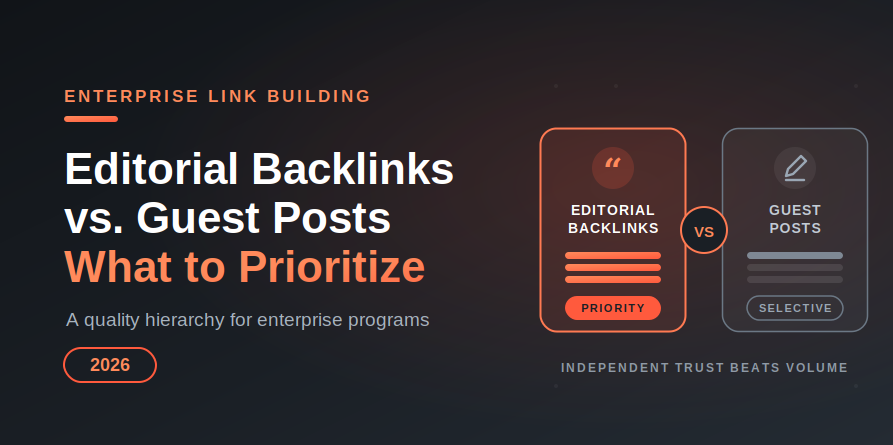
Two Tactics, Very Different Trust Signals
Editorial backlinks and guest posts both appear in enterprise link building programs, yet they are not interchangeable. Confusing them leads to misallocated effort, inflated reports, and weaker long-term outcomes. Understanding the difference—and knowing what to prioritize—helps marketing leaders build domain authority in a way that supports durable organic growth.
Editorial backlinks are citations earned when a publisher independently references your brand, research, product, or expert point of view within their own content. Guest posts are contributed articles you supply (or heavily shape) that publish on a third-party site, typically including a link back to your property. Both can be white-hat when executed with integrity. Only one consistently sits at the top of the quality hierarchy for enterprise programs.
Link Building Agency advises clients to treat editorial coverage as the strategic center of gravity, with selective guest contributions as a supporting channel—never the other way around.
What Makes an Editorial Backlink Valuable
Editorial backlinks carry persuasive trust because a third party chose to cite you. That independence is visible to readers and meaningful as a quality signal. When a respected industry journal quotes your research, or a business publication links to your analysis while explaining a market shift, the link is contextual, earned, and usually retained as long as the article lives.
For enterprises, the secondary benefits are equally important. Editorial mentions often bring brand exposure to sophisticated audiences, referral traffic with genuine intent, and social proof that sales and partnerships teams can reuse. Domain authority gains tend to be more meaningful when the linking domains are topically aligned and editorially rigorous.
How editorial links are typically earned
White-hat pathways include digital PR around newsworthy data, expert commentary for journalists, research distribution, product news that merits coverage, and relationship-driven features. A specialized link building agency orchestrates these motions with message discipline and publisher awareness so the brand appears helpful rather than promotional.
What Guest Posts Can—and Cannot—Deliver
Guest posting can still play a legitimate role. A thoughtful contributed article on a high-standard industry site can showcase expertise, introduce frameworks, and include a natural contextual link. When the host maintains strict editorial review, rejects thin content, and serves a relevant audience, the placement can support visibility and authority.
Problems arise when guest posts become industrialized. Networks of interchangeable blogs, near-duplicate articles, and forced commercial anchors turn a potentially white-hat tactic into a manipulative pattern. Search systems have spent years reducing the value of such schemes. Enterprises that over-index on low-grade guest posting often see activity without commensurate organic growth.
The enterprise risk profile of guest posting
Guest contributions put your brand’s byline and claims on someone else’s platform. That increases legal and reputation exposure if facts are weak or tone drifts. It also creates dependency on hosts whose outbound link policies may change. Editorial backlinks, by contrast, usually involve less promotional control—and correspondingly less appearance of self-dealing.
A Direct Comparison for Decision Makers
Independence and trust
Editorial backlinks win. Third-party citation is harder to dismiss as marketing. Guest posts can be trustworthy, but readers and algorithms both understand the contributor’s incentive.
Scalability
Guest posts can appear more scalable because contribution pipelines are controllable. That scalability is often illusory: quality guest inventory is limited, and forcing volume degrades standards. Editorial programs scale through better assets, stronger relationships, and sharper newsworthiness—not through unlimited article factories.
Brand safety
Both require governance. Editorial coverage can still misquote or frame a story poorly, which is why media training and briefing documents matter. Guest posts require even tighter pre-publication controls because you are supplying the narrative. Enterprise link building must account for both failure modes.
Impact on domain authority and rankings
High-quality editorial backlinks from relevant, authoritative domains generally produce stronger effects on domain authority and competitive visibility. Strong guest posts on reputable sites can contribute, especially when they attract secondary citations. Weak guest posts rarely justify their operational cost.
Measurement clarity
Editorial wins are easier to celebrate internally: independent coverage is a clear brand and SEO success. Guest posts require careful classification so stakeholders do not equate all “links secured” with equal value. Mature reporting separates the two.
What Enterprises Should Prioritize
Prioritize editorial backlinks as the primary authority engine, then map them to commercial destinations through strategic link acquisition. Build the operating system that makes them possible: linkable research, expert availability, PR coordination, and a link building agency skilled in white-hat outreach to real editors.
Use guest posts selectively when:
- The host publication has genuine audience authority in your category
- Editorial standards are strict and publicly evident
- The topic advances thought leadership rather than thin promotion
- Anchors and placement remain natural
- Legal and brand teams can review before publication
If a guest opportunity fails those tests, decline it—even if it would pad monthly totals. Protecting profile quality protects organic growth.
Designing a Portfolio Mix
A healthy enterprise mix might emphasize editorial acquisition while allowing a minority share of premium contributions. Exact ratios vary by industry maturity and newsflow. Categories with frequent data releases and executive visibility may earn more editorial coverage. Highly technical B2B niches may rely more on deep contributed explainers—still on high-bar sites only.
The portfolio should also diversify formats: features, quotes, resource inclusions, and research citations. Diversity that emerges from real opportunities looks natural. Diversity manufactured to “look natural” often does not.
Align assets to the channel
Editorial programs thrive on news hooks, proprietary data, and quotable expertise. Guest programs thrive on evergreen frameworks and practitioner insights. Link Building Agency helps enterprises map content calendars so the right assets feed the right channel instead of forcing every URL into every tactic.
Operational Best Practices for Both
Whether pursuing editorial backlinks or guest posts, white-hat discipline applies:
- Relevance over raw metrics
- Transparent outreach and honest representation of relationships
- Accurate claims with substantiation
- Natural anchors and contextual placement
- Retention monitoring after publication
- Clear classification in reports
A premium link building agency should educate stakeholders on these distinctions rather than blurring them to make results look larger.
Common Mistakes to Avoid
Enterprises frequently err by:
- Treating guest post volume as a proxy for strategy
- Accepting “editorial” labels for paid or network placements without disclosure clarity
- Starving PR and research investment while expecting editorial coverage
- Ignoring internal linking after high-value citations land
- Celebrating domain authority movement without checking relevance and retention
Correcting these mistakes usually improves performance more than adding another outreach vendor.
The Strategic Bottom Line
Editorial backlinks should be the priority for enterprise link building because they embody independent trust, stronger brand association, and more reliable contribution to domain authority and organic growth. Guest posts can support the program when quality is exceptional and governance is tight—but they should not define it.
Choose tactics that your brand can defend and your audience can respect. Partner with a link building agency—such as Link Building Agency—that refuses to conflate activity with authority. When editorial excellence leads and contributions follow selectively, white-hat link building becomes a compounding advantage rather than a content treadmill.