
Global brands rarely fail international SEO because they lack translations. They fail because authority does not travel cleanly across borders. A domain that dominates in one market can remain nearly invisible in another—even when products, pricing, and site architecture are otherwise ready.
Multi-regional link building closes that gap. It is the practice of earning relevant, high-trust citations in each target market—often through local digital PR and media relations—so search engines and audiences recognize the brand as a credible local participant, not merely a foreign site with localized copy.
At Link Building Agency, we design multi-regional programs for enterprises that need disciplined expansion: clear market prioritization, culturally fluent outreach, and authority frameworks that strengthen local visibility without creating risky or inconsistent link profiles.
Why Global Authority Does Not Automatically Transfer
Search engines evaluate relevance in context. A powerful referring domain in the United States may contribute little to rankings in Germany, Japan, or Brazil if the linking site has no meaningful local audience, language alignment, or topical presence in that market.
Several forces make international authority harder than domestic campaigns:
- Local competitors already hold dense regional citation networks
- Language and cultural nuance determine whether content earns editorial interest
- Country-code domains, subfolders, and subdomains distribute equity differently
- Publisher ecosystems vary widely in quality, commercialization, and editorial standards
- Brand perception and trust signals are market-specific
Enterprises that rely on a single global outreach engine often produce English-centric placements that look active in aggregate reports while leaving priority markets underdeveloped.
Start With Market Prioritization, Not Uniform Coverage
The most expensive mistake in multi-regional link building is treating every market as equal. Expansion should follow commercial logic.
Rank markets by opportunity and readiness
Assess revenue potential, competitive intensity, current organic share, localized content maturity, and operational capacity for PR and compliance. A market with strong product-market fit and weak local SEO competition may deserve acceleration. A market with regulatory complexity and thin localized content may need foundational work before aggressive outreach.
Define the authority objective per market
Some markets require brand trust building first—coverage that establishes legitimacy with local media and industry institutions. Others need commercial category reinforcement for high-intent queries. Still others benefit from partnership ecosystems: associations, universities, suppliers, and professional communities that shape local search neighborhoods.
Link Building Agency begins every multi-regional engagement with a market matrix that maps business priority to authority strategy. Without that matrix, teams scatter effort across markets that cannot convert visibility into demand.
Choose Destination Architecture With Intention
International site structure influences how acquired links should be assigned.
Subfolders, subdomains, and ccTLDs
Subfolder models (example.com/de/) often consolidate equity under a primary domain and can simplify global reporting. Country-code domains and some subdomain setups may better signal local focus but require more deliberate local citation building because authority is less automatically shared.
There is no universal winner. The correct approach depends on brand history, legal constraints, hosting and performance realities, and how search engines already interpret the existing footprint. Link building strategy must follow that architecture, not fight it.
Local landing priorities
In each market, identify the pages that should receive external support: localized homepages, category hubs, thought leadership in the local language, and strategic commercial landing pages. Avoid spreading placements across low-value templates simply because they exist in translation.
Build Locally Relevant Assets
Translated press releases are rarely enough. Markets respond to assets that feel native to local conversations.
Local data and regional insight
Regional benchmarks, market-specific surveys, and localized industry analyses give journalists a reason to cite your brand. Global research can be adapted when methodology and sampling are transparent, but purely recycled English assets often underperform.
Cultural and regulatory fluency
Healthcare, finance, education, alcohol, and other regulated categories require market-aware messaging. Outreach claims that are acceptable in one jurisdiction may be restricted in another. Enterprise programs need review pathways that prevent compliance failures at the outreach stage.
Partnership-led content
Local chambers, trade associations, universities, and industry events can produce durable citations when collaboration is genuine. These relationships often take longer to cultivate than transactional placements, but they create authority that competitors cannot easily replicate.
Run Outreach Through Local Publisher Ecosystems
A multi-regional campaign succeeds or fails in publisher selection.
Build market-specific media maps
Each market needs its own inventory of relevant publications, journalists, newsletters, industry portals, and niche authorities. Global media lists are a starting point, not a substitute. Local search visibility is shaped by local editorial neighborhoods.
Staff for language and cultural competence
Outreach written by non-native speakers frequently reveals itself through tone, framing, or irrelevant angles. Enterprise brands should insist on native or near-native communication for high-priority markets, plus editorial QA that protects brand voice across languages.
Balance global brand consistency with local relevance
The brand story should remain coherent worldwide, but the proof points, examples, and news hooks must adapt. What resonates as innovation storytelling in one market may need a reliability or community-impact framing in another.
Avoid Common Multi-Regional Link Risks
International programs introduce failure modes that domestic campaigns rarely face.
Over-concentrated anchors and destinations
Repeating exact-match commercial anchors across many markets creates unnatural patterns. Diversify anchors and distribute destinations thoughtfully within each locale.
Low-quality local directories
Some markets have denser networks of low-editorial sites willing to publish almost anything. Volume from those sources can look attractive in dashboards while damaging long-term trust. Quality thresholds must remain high even when local inventory is thinner.
Ignoring geo and language signals
A placement on a globally recognized English site is not automatically a substitute for local-language coverage. Both can be valuable, but they play different roles. Enterprise reporting should distinguish global brand amplification from market-level authority building.
Fragmented ownership
When regional marketing teams, global SEO, and agency partners operate without a shared governance model, markets diverge. One region may pursue aggressive tactics while another maintains strict brand standards. That inconsistency creates both SEO and reputational risk.
Governance That Scales Across Regions
Multi-regional link building is an operating system, not a campaign calendar.
Establish clear ownership for market strategy, publisher approval, content localization, legal review, and performance reporting. Create shared definitions of quality so regional teams are not inventing standards in isolation. Maintain a central view of the global link profile while allowing market-level nuance in execution.
Link Building Agency uses this dual structure with enterprise clients: centralized quality and measurement, decentralized market fluency. Global leadership retains visibility and control. Local execution retains authenticity and relevance.
Measurement Across Borders
Executive stakeholders need clarity on whether international authority investments are working.
Useful multi-regional measurement includes:
- Local ranking movement for priority queries in each language and market
- Organic traffic and conversion trends on localized URL clusters
- Growth in relevant referring domains by market, not only global totals
- Share of voice against local competitors
- Coverage quality indicators such as publication tier, topical fit, and destination alignment
Be careful with blended global KPIs. A surge of easy placements in one secondary market can mask stagnation in a priority market. Report by market first, then roll up.
Sequencing Expansion for Compounding Advantage
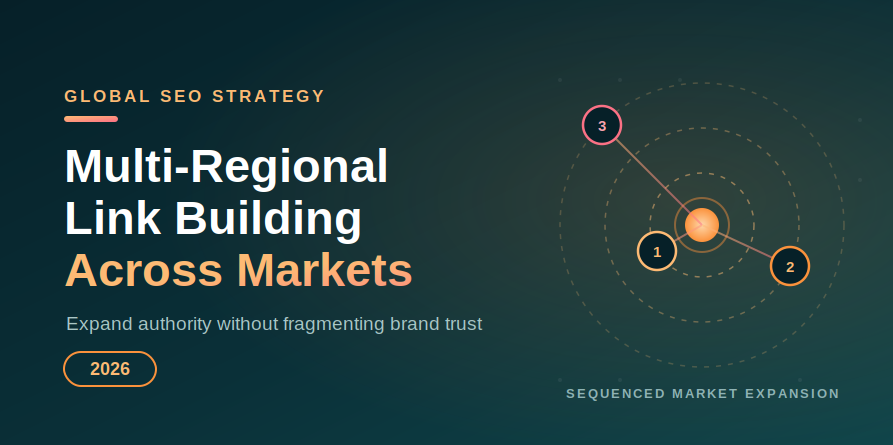
The strongest international programs expand in waves. Secure a credible foothold in the highest-priority markets, institutionalize what works, then extend the playbook. Attempting simultaneous launches across too many regions often dilutes creative quality, weakens publisher relationships, and overwhelms internal approval capacity.
A sequenced model also creates reusable assets: research methodologies, pitch frameworks, and brand narratives that can be adapted rather than reinvented for every new country.
The Enterprise Advantage
Multi-regional link building rewards organizations that can combine brand prestige with operational discipline. Enterprises already possess the ingredients local publishers often want—data, executives, product innovation, and customer stories. The challenge is translating those assets into market-native authority at scale.
That is the work Link Building Agency performs for global brands: prioritizing markets with commercial rigor, building locally relevant acquisition engines, and expanding authority without fragmenting trust.
If your international growth plan depends on organic search, localized pages alone will not be enough. Authority must be earned where your customers live, read, and decide. Multi-regional link building is how enterprise brands make that authority real.