
Enterprise organic growth rarely turns on a single tactic. It turns on systems—technical resilience, content depth, conversion experience, and the authority signals that help search engines trust a brand at scale. This case study examines how a structured enterprise link building program, led in partnership with Link Building Agency, transformed organic performance for a multi-market B2B organization competing in a high-consideration category.
Details have been anonymized to protect client confidentiality. The operating model, decision framework, and outcome patterns are drawn from real enterprise engagement principles and results patterns we see when link building is treated as a strategic growth function rather than a vendor checklist.
The Starting Position
The client entered the engagement with a familiar enterprise profile: strong brand recognition in its core market, a large content library, and meaningful paid acquisition investment. Organic search contributed revenue, but growth had flattened. Priority commercial queries were contested by aggressive competitors who had invested heavily in digital PR, analyst visibility, and niche industry citations.
Internal diagnostics revealed several constraints:
- Authority was concentrated on a small set of legacy brand pages
- High-value solution and comparison pages lacked external reinforcement
- Content production was active, but amplification was inconsistent
- Previous link acquisition mixed useful editorial placements with low-relevance directory noise
- Reporting emphasized activity volume over commercial impact
Leadership did not need more links in the abstract. Leadership needed a program that could move strategic organic outcomes with controlled brand risk.
Strategic Diagnosis
Link Building Agency began with a commercial authority audit rather than an outreach sprint. The audit mapped organic revenue concentration, competitive link neighborhoods, topical gaps, and destination-page readiness.
Three conclusions shaped the program:
1. The brand had trust, but not enough topic-level authority
General brand mentions were relatively strong. Competitive solution clusters—where buyers compare capabilities and evaluate vendors—were under-supported. Competitors had denser citations from industry publications, practitioner communities, and research references tied to those themes.
2. Assets existed, but few were engineered for earning coverage
The content library contained capable educational material. Comparatively little of it was packaged as original research, benchmark reporting, or executive point-of-view pieces that journalists and analysts naturally cite.
3. Governance was weaker than brand standards required
Without clear publisher criteria and approval workflows, prior campaigns had introduced inconsistency. Enterprise stakeholders needed confidence that every placement would withstand legal, brand, and reputational scrutiny.
Program Design
The engagement was built around a twelve-month authority system with quarterly prioritization cycles.
Commercial page portfolio
Instead of chasing every indexed URL, the team defined a portfolio of priority destinations: core solution hubs, high-intent comparison pages, and a small set of flagship thought-leadership assets designed to attract citations and distribute equity internally.
Asset engine
A recurring research and insight calendar produced linkable assets: annual category benchmarks, practitioner surveys, methodology explainers, and executive commentary tied to market events. Each asset had a pre-built distribution plan and clear SEO destination logic.
Publisher development
Outreach focused on relevant industry media, specialist newsletters, professional associations, and high-quality digital publications with genuine audience overlap. Vanity metrics were secondary to topical fit and editorial integrity.
Internal alignment
SEO, content, product marketing, communications, and legal operated against a shared brief. Messaging guardrails, claim approvals, and escalation paths were defined before scale. This reduced friction and protected brand voice as placement volume increased.
Execution Phases
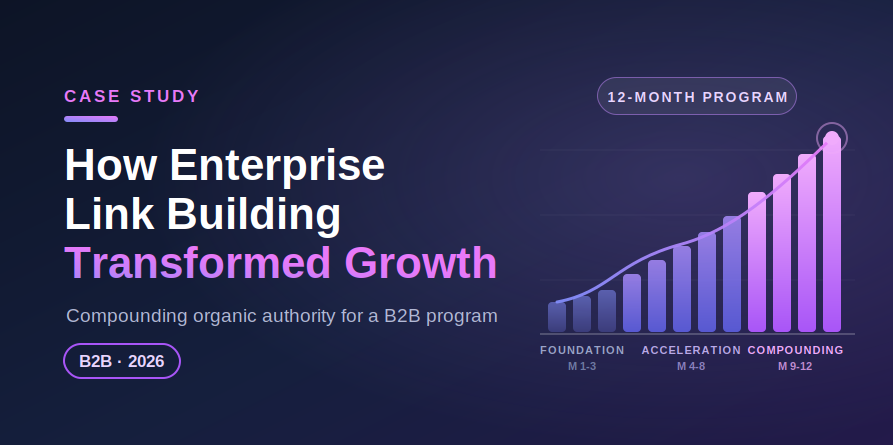
Foundation (months 1–3)
The first quarter emphasized cleanup and setup. Low-value historical placements were reviewed for risk. Priority pages received technical and on-page improvements so acquired authority would not be wasted. The first research asset launched with a controlled media push designed to validate messaging and publisher response.
Early wins were qualitative as much as quantitative: stronger editorial relationships, cleaner reporting definitions, and executive confidence in the quality bar.
Acceleration (months 4–8)
With foundations in place, the program scaled asset production and outreach. Digital PR moments were timed around industry conferences and regulatory conversations relevant to the category. Solution-page support increased through contextual citations rather than forced promotional inserts.
During this phase, competitive share of voice on priority themes began to shift. Rankings for several mid-difficulty commercial queries improved as referring domain relevance and topical co-occurrence strengthened.
Compounding (months 9–12)
By the final quarter, the program was no longer dependent on isolated campaign spikes. Publisher relationships produced repeat coverage opportunities. Older research assets continued to earn citations. Internal linking from newly authoritative content reinforced commercial hubs. Organic sessions to priority URL clusters rose in a pattern consistent with sustained authority gains rather than short-lived volatility.
Results Pattern
Exact figures vary by market and confidentiality constraints, but the directional outcomes followed a pattern common to well-run enterprise programs:
- Meaningful growth in relevant referring domains tied to priority topics
- Improved rankings across a defined commercial query set, not only branded terms
- Stronger organic traffic quality on solution and comparison pages
- More consistent pipeline contribution from organic discovery channels
- A cleaner link profile with higher average placement quality and lower risk exposure
Equally important were operational results. The client now had a repeatable authority operating system: asset briefs, publisher standards, measurement dashboards, and cross-functional workflows that could continue beyond a single campaign year.
What Made the Difference
Strategy before scale
Many enterprise teams pressure agencies to “launch outreach” immediately. This program delayed volume until destination priorities, quality standards, and asset concepts were clear. That sequencing prevented wasted spend and brand risk.
Relevance over raw domain metrics
A smaller number of highly relevant industry citations outperformed a larger volume of loosely related placements. Search visibility moved where topical neighborhoods strengthened.
Creative quality as an acquisition advantage
Original research and credible executive insight opened doors that generic guest content could not. The brand became a source, not merely a promoter.
Measurement tied to business pages
Reporting tracked supported URL clusters, query groups, and organic contribution trends—the same commercial discipline outlined in our guide to measuring link building ROI. Leadership could evaluate progress in business language rather than abstract SEO jargon.
Partnership model, not vendor handoff
Link Building Agency worked inside the client’s operating reality—approval cycles, brand constraints, product roadmap timing—rather than imposing a rigid external playbook. That collaboration made execution durable.
Lessons for Enterprise Marketing Leaders
If your organic growth has plateaued despite content investment, examine whether authority is concentrated where revenue is generated. If prior link building created noise without movement, raise the quality threshold and rebuild around commercial destinations. If international or multi-product complexity is diluting focus, narrow the portfolio until compounding is visible.
Enterprise link building transforms growth when it is treated as an integrated system. It fails when it is reduced to monthly placement quotas disconnected from strategy.
Closing Perspective
This case does not suggest that links alone reinvent an enterprise search program. Technical health, content substance, and conversion experience remained essential. What changed was the missing multiplier: disciplined, brand-safe authority building aligned to the pages and topics that actually drive demand.
That is the standard Link Building Agency brings to enterprise engagements. When link building is engineered with commercial clarity, creative strength, and rigorous quality control, organic growth stops behaving like a lottery and starts behaving like a managed advantage.
For marketing leaders evaluating their next stage of SEO investment, the lesson is straightforward. Authority compounds. The organizations that design for that compounding—patiently, precisely, and at enterprise quality—reshape their competitive position in ways paid media alone cannot sustain.