
Enterprise leaders do not fund link building because referring domain charts look impressive. They fund it because organic search should produce durable demand at a cost and risk profile that other channels cannot match. The challenge is measurement. Link building sits upstream of rankings, rankings sit upstream of traffic, and traffic influences pipeline through journeys that rarely attribute cleanly to a single placement.
That complexity is real. It is not an excuse for vague reporting. At Link Building Agency, we help enterprise teams measure link building ROI with commercial discipline: clear hypotheses, layered metrics, realistic time horizons, and decision frameworks that separate leading indicators from lagging business outcomes.
Why Traditional ROI Formulas Break Down
A simplistic formula—revenue attributed to organic search divided by link building investment—fails for several reasons.
First, organic performance is multi-causal. Technical changes, content updates, competitive movement, seasonality, and brand demand all interact with authority signals. Second, links often influence groups of pages and queries rather than a single landing experience. Third, the value of authority compounds over time; a placement earned this quarter may support rankings for years. Fourth, enterprise attribution models frequently under-credit organic assist paths in long B2B and high-consideration B2C cycles.
If leadership demands a single perfect ROI number, teams will either overclaim or underinvest. Mature measurement aims for decision-grade confidence, not false precision.
Build a Measurement Stack, Not a Single Metric
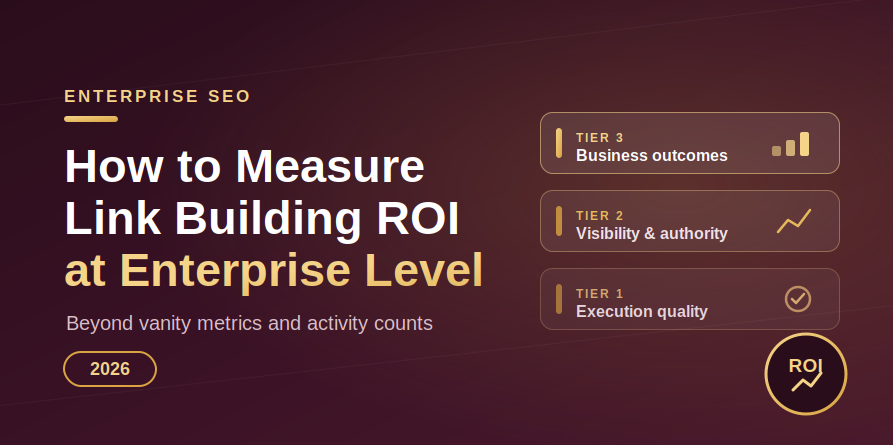
Enterprise link building ROI should be evaluated through stacked evidence.
Tier 1: Execution quality and risk control
These metrics confirm that investment is producing the right kind of activity:
- Number and quality distribution of placements
- Topical relevance of referring domains
- Destination alignment to priority pages
- Anchor diversity and naturalness
- Rejection or risk flags caught before publication
Weak Tier 1 performance means ROI discussions are premature. Poor-quality acquisition can create future cleanup costs that erase apparent gains.
Tier 2: Visibility and authority response
These metrics show whether search engines and competitive landscapes are responding:
- Ranking movement for priority query clusters
- Share of voice against named competitors
- Organic impressions and click trends on supported URL groups
- Growth in relevant referring domains and citation neighborhoods
- Improvements in page-level or cluster-level authority indicators used by your analytics stack
Tier 2 is where most credible SEO teams demonstrate progress within one to two quarterly cycles, depending on competition and crawl dynamics.
Tier 3: Business outcomes
These metrics connect organic gains to commercial value:
- Organic sessions and engaged sessions on revenue pages
- Assisted and last-click conversions from organic
- Pipeline influence or opportunity creation where CRM integration exists
- Revenue contribution trends for supported product or solution lines
- Reduced dependency on paid search for priority non-brand queries where that is a strategic goal
Tier 3 moves more slowly and requires careful isolation logic. It is also the layer executives care about most.
Define the Unit of Analysis Correctly
One of the most important measurement decisions is what you evaluate.
Prefer page clusters over isolated URLs
Enterprise sites rarely win through one URL alone. Measure supported commercial clusters: a solution hub plus related comparison and educational pages, or a category family in e-commerce. Link equity and relevance often distribute across related templates.
Prefer query groups over single keywords
A campaign may lift a constellation of related terms before the head term moves. Track priority groups with commercial weighting so progress is visible even when one vanity keyword lags.
Separate branded and non-branded performance
Brand demand can inflate organic totals and obscure whether authority investments are expanding acquisition capacity. Non-brand commercial visibility is usually the clearer signal of link building contribution.
Establish Baselines and Observation Windows
ROI measurement collapses without baselines.
Before scaling outreach, capture ranking baselines for priority clusters, organic traffic and conversion baselines for destination groups, competitive share-of-voice snapshots, and current referring domain quality composition. Define observation windows that match market reality. In highly competitive enterprise categories, meaningful Tier 2 movement may require several months. Expecting transformational Tier 3 ROI in thirty days usually leads to bad decisions.
Link Building Agency typically aligns measurement windows to quarterly business reviews while maintaining monthly leading-indicator dashboards for operational control.
Use Counterfactuals and Competitive Controls
Because controlled experiments are difficult in organic search, enterprises should use practical quasi-controls.
Compare supported clusters against similar unsupported clusters when feasible. Track competitor movement to distinguish market-wide shifts from program-specific gains. Annotate major non-link changes—site migrations, product launches, PR crises, algorithm updates—so causal stories remain honest.
Perfect isolation is rare. Transparent annotation and comparative framing still raise confidence dramatically.
Connect Finance Language to SEO Reality
CFOs and growth leaders think in terms of efficiency, payback, and risk-adjusted return. Translate SEO metrics carefully.
Efficiency framing
Discuss the cost of acquiring durable organic visibility relative to paid alternatives for the same query demand—without reducing the conversation to short-term cost-per-click equivalence. Organic authority is an asset with residual value; paid clicks generally are not.
Payback framing
Estimate the organic contribution uplift associated with supported clusters over a defined period, then relate that uplift to program investment. Present ranges and confidence levels rather than false exactness.
Risk framing
Include the value of avoided downside: toxic profile cleanup, brand-unsafe placements, or volatile tactics that create future volatility. Enterprise ROI includes risk management, not only upside capture.
Avoid Vanity Metrics That Distort Decisions
Several metrics commonly overstate progress:
- Raw link counts without relevance or quality context
- Domain rating averages disconnected from topical neighborhoods
- Traffic spikes from temporary news coverage with no lasting destination strategy
- Branded ranking improvements attributed to authority work they did not cause
- Activity reports that celebrate outreach volume over accepted editorial quality
A dashboard full of green indicators can still represent weak ROI if those indicators are not tied to commercial destinations and durable visibility.
Create a Decision Cadence
Measurement only creates value when it drives decisions.
Monthly, review leading indicators and quality controls. Adjust publisher targets, asset angles, and destination priorities. Quarterly, evaluate Tier 2 movement and early Tier 3 signals against hypotheses. Biannually or annually, reassess portfolio allocation: which markets, products, and clusters deserve accelerated authority investment, and which should be maintained.
This cadence prevents two failure modes: abandoning programs before compounding begins, and continuing underperforming motions out of inertia.
Organizational Requirements for Credible ROI
Tools alone do not create measurement maturity. Enterprises need shared definitions across SEO, analytics, finance, and marketing leadership. They need CRM and analytics instrumentation capable of capturing organic influence. They need content and technical teams ready to capitalize on authority gains. And they need agency partners willing to report uncertainty honestly.
Link Building Agency builds measurement frameworks with clients rather than imposing generic scorecards. The objective is executive clarity: what was done, what changed, what remains uncertain, and what decision that evidence supports.
A Practical ROI Narrative Leadership Can Trust
A strong enterprise report does not claim that every conversion was caused by a backlink. It shows that priority clusters received high-quality, relevant authority; that visibility and engagement moved in ways consistent with that investment; that competitive position improved on commercially meaningful terms; and that business contribution trends support continued allocation.
That narrative is rigorous enough for sophisticated stakeholders and humble enough to remain credible.
Closing Perspective
Measuring link building ROI at the enterprise level is an exercise in systems thinking. Authority is an asset. Assets appreciate through compounding. Compounding is visible first in quality and visibility, then in demand and revenue. Teams that respect that sequence make better investment decisions than teams chasing a single perfect attribution coefficient.
If your organization needs a measurement model that stands up in executive review—and a link building program designed to produce evidence, not just activity—Link Building Agency can help you connect premium acquisition work to outcomes that matter.
In enterprise search, the brands that measure well do not merely justify budgets. They allocate authority investment with precision, protect brand equity, and turn organic growth into a managed financial advantage.