
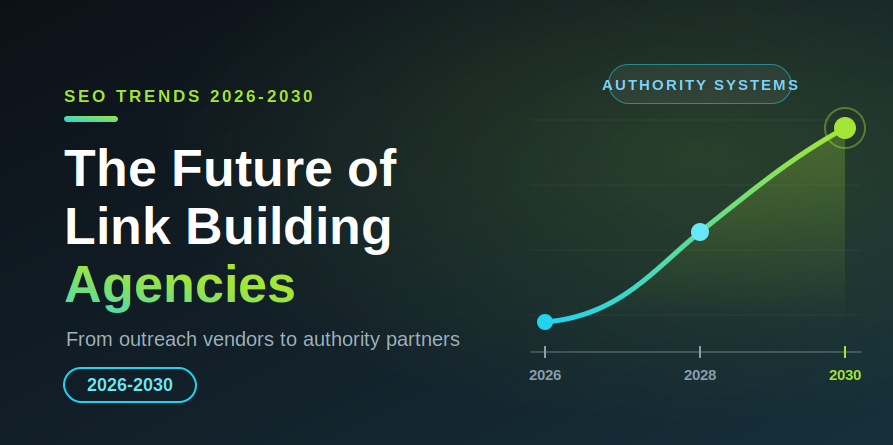
Link building agencies are entering a decisive period. Between 2026 and 2030, the firms that thrive will look less like outreach factories and more like authority strategy partners—fluent in brand risk, media dynamics, data storytelling, and the evolving ways search systems interpret trust.
The underlying need is not disappearing. Enterprises still require credible third-party validation to compete in organic search. What is changing is how that validation is earned, evaluated, and operationalized. At Link Building Agency, we see five structural shifts that will redefine premium link building over the next half-decade.
Shift 1: From Link Acquisition to Authority Systems
The strongest agencies are already moving beyond placement-centric delivery. Clients no longer win by accumulating disconnected mentions. They win by building authority systems that combine:
- Digitally newsworthy assets and research programs
- Publisher relationship development over one-off transactions
- Destination strategy tied to commercial architecture
- Internal linking and content models that distribute acquired equity
- Measurement frameworks connected to business outcomes
By 2030, enterprise buyers will expect agencies to operate as integrated authority partners. Pure outreach vendors that cannot contribute strategy, creative, and governance will be relegated to low-value work—or replaced.
Link Building Agency’s model anticipates this shift: campaigns are designed as compounding systems, not monthly link quotas.
Shift 2: AI Changes Workflows, Not Trust Requirements
Artificial intelligence will continue to accelerate research, prospecting, personalization drafts, and reporting. That productivity gain is real. It will not eliminate the need for human judgment in brand-sensitive environments.
Where AI will matter most
Agencies will use AI to map topical neighborhoods faster, identify emerging publisher opportunities, summarize competitive citation landscapes, and support creative ideation for research angles. Reporting will become more narrative and less manually assembled.
Where AI will not replace premium operators
Publishers will remain wary of low-quality, machine-generated pitches. Enterprise brands will remain intolerant of tone-deaf outreach that creates reputational risk. Editorial relationship building, claim accuracy, and strategic prioritization will stay human-led in high-stakes categories.
The agencies that succeed will treat AI as leverage for expert teams, not as a substitute for expertise. The agencies that spam at machine scale will create short-term noise and long-term trust problems for their clients.
Shift 3: Entity, Brand, and Experience Signals Rise Alongside Links
Search systems increasingly interpret brands as entities embedded in broader knowledge and experience ecosystems. Classic backlinks remain important, but they operate alongside brand search demand, unlinked mentions, topical consistency, co-occurrence patterns, and user experience quality.
Implications for agency strategy
Future-ready agencies will counsel clients on more than hyperlink acquisition. They will help shape the public evidence of expertise: citations in credible media, associations with recognized institutions, original research footprints, and coherent topical identity across markets.
This does not mean abandoning links. It means understanding links as one expression of authority within a wider trust graph. Enterprises that optimize only for raw referring domains while neglecting brand and entity coherence will underperform peers who build richer authority narratives.
Shift 4: Quality Thresholds Harden as Manipulation Gets Easier
As content generation and outreach automation become cheaper, low-quality link supply will expand. Search systems and sophisticated brands will respond by valuing scarcity: editorial integrity, genuine audience relevance, and placements that would exist even without SEO motive.
Enterprise procurement will get stricter
By the late 2020s, more enterprises will formalize publisher quality standards, disclosure expectations, and risk audits as part of agency governance. Legal, communications, and SEO stakeholders will share approval models. Agencies unable to document quality rationale will struggle in procurement processes.
The premium segment will widen from the commodity segment
The market will bifurcate more sharply. Commodity providers will compete on volume and speed. Premium agencies will compete on judgment, creativity, market fluency, and defensibility. Link Building Agency is built for that premium segment—where brand safety and strategic impact outweigh vanity volume.
Shift 5: Multi-Regional and Multi-Product Complexity Becomes the Norm
Global enterprises increasingly need authority programs that span languages, regions, and product lines without fragmenting standards. The future agency must combine centralized quality control with localized execution capability.
This requires talent networks, translation and cultural adaptation processes, regional media intelligence, and reporting that can distinguish global brand amplification from local market authority. Agencies designed only for English-language domestic campaigns will find enterprise wallets harder to win.
What Enterprises Should Demand From Agencies Through 2030
Procurement checklists should evolve with the market.
Demand commercial strategy fluency
Ask how the agency prioritizes destinations, query clusters, and markets. If the answer begins and ends with domain metrics, keep looking.
Demand creative and research capability
Authority is increasingly earned through assets worth citing. Agencies that cannot conceptualize and distribute original insight will rely on weaker tactics.
Demand transparent quality governance
Require clear publisher criteria, escalation paths, and documentation. Premium work should be auditable.
Demand measurement maturity
Activity reports are insufficient. Agencies should connect leading indicators to visibility and business contribution with honest confidence ranges.
Demand AI literacy without AI recklessness
Partners should explain where automation improves quality and where human oversight remains non-negotiable.
The Agency Operating Model of the Future
By 2030, leading link building agencies will resemble hybrid organizations:
- Strategists who understand enterprise growth architecture
- Researchers and editors who create cite-worthy intellectual property
- Media specialists who build durable publisher relationships
- Analysts who translate SEO movement into executive decisions
- Operators who manage multi-market governance at scale—including white-label delivery for agencies that need confidential capacity
Technology will support each function. Culture and standards will differentiate the winners.
Risks on the Horizon
Not every trend is benign. Algorithmic volatility may punish over-optimized patterns more aggressively. Generative content may flood publisher inboxes and raise skepticism toward outreach. Economic pressure may tempt brands to chase cheaper acquisition channels with hidden risk. Agencies that educate clients through these pressures—rather than merely fulfilling purchase orders—will become trusted advisors.
There is also reputational risk in over-promising certainty. Search will remain probabilistic. The best partners will communicate in ranges, scenarios, and decision frameworks instead of guaranteed outcomes.
How Link Building Agency Is Preparing Clients for What Comes Next
Link Building Agency’s perspective is straightforward. The future belongs to authority partners who can earn trust in public, defend quality under scrutiny, and connect organic investment to enterprise growth priorities. We invest in research-led acquisition, rigorous publisher standards, multi-regional fluency, and measurement systems designed for executive review.
We also treat emerging technology as an amplifier for expert work, not a license to industrialize low-quality tactics. That philosophy will matter more every year as automation lowers the cost of mediocrity.
Closing Perspective
From 2026 to 2030, link building agencies will be judged less by how many links they can generate and more by whether they can build durable, brand-safe authority in an environment of rising noise. Enterprises that choose partners accordingly will enter the next decade with stronger organic moats. Enterprises that optimize for short-term volume will spend the next decade cleaning up.
The future of the category is not the end of link building. It is the maturation of link building into a true strategic discipline. For brands ready to operate at that level, agencies like Link Building Agency are not vendors of placements. They are architects of compounding authority.