
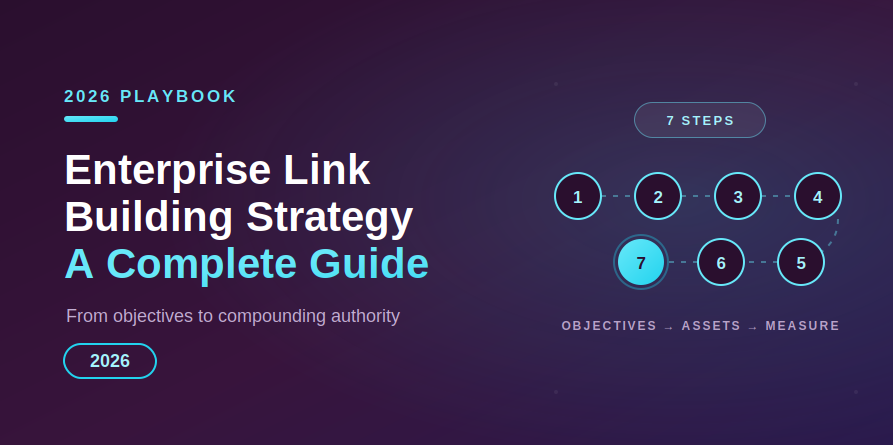
Why Enterprise Link Building Demands Its Own Playbook
Enterprise link building is not a larger version of a startup outreach campaign. The stakes, constraints, and opportunity surfaces are different. Multi-brand portfolios, global markets, regulated messaging, and complex site architectures all shape how authority should be earned. In 2026, search visibility still rewards trustworthy citations—but the bar for quality, relevance, and governance has never been higher.
A complete enterprise link building strategy aligns business priorities with white-hat acquisition methods. It defines which properties and URLs deserve investment, which publishers can credibly confer authority, and how success will be measured beyond vanity referring-domain counts. Link Building Agency builds programs around that discipline: editorial backlinks that strengthen domain authority and compound into organic growth, without exposing the brand to manipulative tactics.
Step 1: Establish Objectives Tied to Revenue and Risk
Before outreach begins, leadership should agree on outcomes. Typical enterprise objectives include supporting commercial landing pages, defending category terms against aggressive competitors, elevating research hubs that feed the funnel, and improving domain authority for newer acquisitions in a portfolio.
Risk posture belongs in the same conversation. Some industries tolerate aggressive PR-style placements; others require legal review on every claim. Documenting risk appetite early prevents friction later and keeps the link building agency accountable to standards the brand can defend.
Translate goals into measurable targets
Useful targets might include net new high-authority referring domains per quarter, share of editorial placements versus lower-tier mentions, ranking movement for a defined URL set, and qualitative retention of links over six to twelve months. Domain authority should be treated as a directional indicator, not a single score to chase in isolation. Organic growth metrics—non-brand clicks, assisted conversions, and visibility by topic cluster—complete the picture.
Step 2: Audit the Current Authority Landscape
Strategy without diagnosis is guesswork. An enterprise audit examines:
- Existing backlink profile quality and toxicity
- Competitive link gaps by market and product line
- Anchor text patterns and over-optimization risk
- Orphaned or underlinked strategic content
- Historical PR and digital coverage that never converted into tracked links
This baseline tells the team where white-hat effort will produce the highest return. It also surfaces cleanup needs before aggressive acquisition begins. Cleaning a polluted profile while simultaneously pursuing editorial backlinks is often necessary for mature brands with years of mixed vendor history.
Step 3: Prioritize Assets That Deserve Links
Not every page should be a link magnet. Enterprises win when they concentrate authority on pages that can absorb it: cornerstone guides, original research, category hubs, comparison resources, and product narratives with genuine differentiation.
Content teams and the link building agency should collaborate on asset readiness. Thin pages, outdated statistics, and weak unique value propositions rarely earn editorial interest—regardless of outreach skill. Investing in linkable assets first improves conversion rates from publisher conversations and protects brand reputation in high-visibility outlets.
Design for citation, not just ranking
Citation-worthy assets typically include proprietary data, expert frameworks, operational benchmarks, or clear explanations of complex industry problems. When Link Building Agency partners with enterprise clients, a common early win is refreshing a research or insight piece so editors have a concrete reason to reference the brand.
Step 4: Build a Publisher and Channel Framework
Enterprise programs usually combine several white-hat channels:
- Editorial features and expert commentary in trade and business media
- Resource-page inclusion where genuinely useful
- Digital PR around newsworthy data or product milestones
- Selective guest contributions when editorial standards are high
- Partnership and community mentions that reflect real relationships
The mix should favor placements that look and behave like journalism or industry education. Guest posts can play a role, but they should not dominate a strategy that aims for durable domain authority. Editorial backlinks from independent coverage generally carry stronger trust signals and better user engagement.
Segment by market and brand
Global enterprises often need market-specific publisher maps. A domain that confers authority in one country may be irrelevant in another. Brand subsidiaries may require separate outreach identities to avoid confusing editors. Segmenting the framework prevents one-size-fits-all messaging that fails to resonate.
Step 5: Operationalize White-Hat Execution
Process is what separates enterprise link building from opportunistic campaigns. Define approval workflows, messaging libraries, claim substantiation requirements, and escalation paths for sensitive topics. Establish quality thresholds for domain relevance, traffic authenticity, and outbound link patterns on target sites.
Outreach should be personalized, research-backed, and respectful of editorial calendars. Volume targets must never override quality gates. A smaller set of retained editorial backlinks will outperform a large batch of disposable placements when the objective is sustainable organic growth.
Align with PR and brand communications
The most effective enterprise programs treat link building as adjacent to—not in conflict with—corporate communications. Shared calendars, embargo awareness, and consistent spokesperson guidance reduce risk and increase placement quality. Link Building Agency frequently coordinates with in-house PR so digital authority work amplifies existing narrative priorities rather than competing with them.
Step 6: Integrate Technical SEO and Content Systems
Links amplify; they do not repair. Crawlability, indexation, internal linking, and page experience determine whether newly earned authority can flow to the pages that matter. Strategy reviews should include technical SEO counterparts so acquisition efforts are not stranded on pages that struggle to rank for structural reasons.
Internal linking plans deserve equal attention. When a high-authority editorial backlink lands on a research hub, thoughtful internal links can distribute equity to commercial URLs. Enterprises that ignore this step leave ranking potential unrealized.
Step 7: Measure, Learn, and Recalibrate Quarterly
A 2026-ready enterprise link building strategy is iterative. Quarterly reviews should examine which publishers retain links, which content angles convert, which markets respond, and how rankings and organic growth correlate with acquisition. Negative outliers—sudden drops, unnatural spikes, or irrelevant domains—require investigation.
Reporting for executives should emphasize decision-ready insight: progress against priority URLs, competitive authority movement, risk flags, and recommended pivots. Raw link dumps without interpretation waste leadership attention and obscure whether the program is working.
Common Pitfalls to Avoid
Several failure modes appear repeatedly in enterprise environments:
- Optimizing for domain authority scores while ignoring relevance and retention
- Over-indexing on guest posts at the expense of true editorial coverage
- Running disconnected campaigns for each brand without shared learning
- Accepting opaque vendor methods that cannot survive an audit
- Neglecting content quality, then blaming outreach for weak results
Avoiding these pitfalls is as important as selecting tactics. White-hat integrity is not a slogan; it is an operating system.
Putting the Guide Into Practice
A complete enterprise link building strategy for 2026 combines clear objectives, rigorous auditing, linkable assets, publisher frameworks, white-hat execution, technical integration, and disciplined measurement. Done well, it raises domain authority in a way that compounds across the site and supports durable organic growth.
Link Building Agency’s perspective is straightforward: treat link acquisition as a strategic capability, not a side project. Enterprises that institutionalize quality editorial backlinks—and partner with a link building agency capable of operating at enterprise standards—create a visibility advantage that competitors struggle to reverse.
Start with priorities, protect brand trust, and build for the long term. That is how enterprise link building becomes a durable growth engine rather than a quarterly experiment.